Showing posts with label Sci-fi books. Show all posts

Monday, February 9, 2026

An Authors Backlist is a Goldmine for Readers and the Author


This is a two-parter. One, the fact that a backlist of books by a single author offers a treasure trove of reading opportunities to the reader, and two, that if the author writes in multiple genres, the reader will discover they love more than one category of book, and that's a blessing on both the author and the reader.

1 One of the unexpected gifts of being an author is discovering that your older stories never really stop traveling. Even when I’m wrapped up in marketing or buried in a new manuscript, sales still appear—sometimes from books I wrote more than a decade ago.

When novels like The Judas Syndrome find new readers 17 years after publication, it reminds me that stories move at their own pace. A novel published in 2009 can still reach someone today, and that feels quietly profound. It means the message isn't dead. That it remains relevant across generations. Does that qualify it as a classic? I dare to hope. 

Regardless, on days when the creative work feels heavy or when my latest release struggles to find its footing, those moments matter. They’re gentle reminders that every book leaves a trail; every story finds its time.

I’m grateful for each sale, and for every reader who chooses to step into a world I created.

2 One of the quiet joys of having a backlist of books that spans multiple genres is watching readers wander through it. Someone might start with one of my sci-fi novels, then drift into my post-apocalyptic stories—or surprise me entirely by picking up my YA fantasy, crime fiction, or even a paranormal cozy mystery.

What stays with me is this: it’s not the genre that carries them forward—it’s the storytelling. Because they connected with one story, they’re willing to take a chance on another, even if it lives in a completely different world.

That feels meaningful to me. It’s a reminder that readers don’t always come for categories—they come for voice, emotion, and connection. And in many ways, it mirrors how I read, too. I’ve never liked being boxed in by genre. Good stories are good stories, wherever they’re found.

I’m grateful to those who continue to find my stories and keep coming back. I hope to continue building worlds and offering new genres to my backlist of books so my readers are never pigeon-holed by a single category when looking for stories from Michael Poeltl.

Friday, May 4, 2018

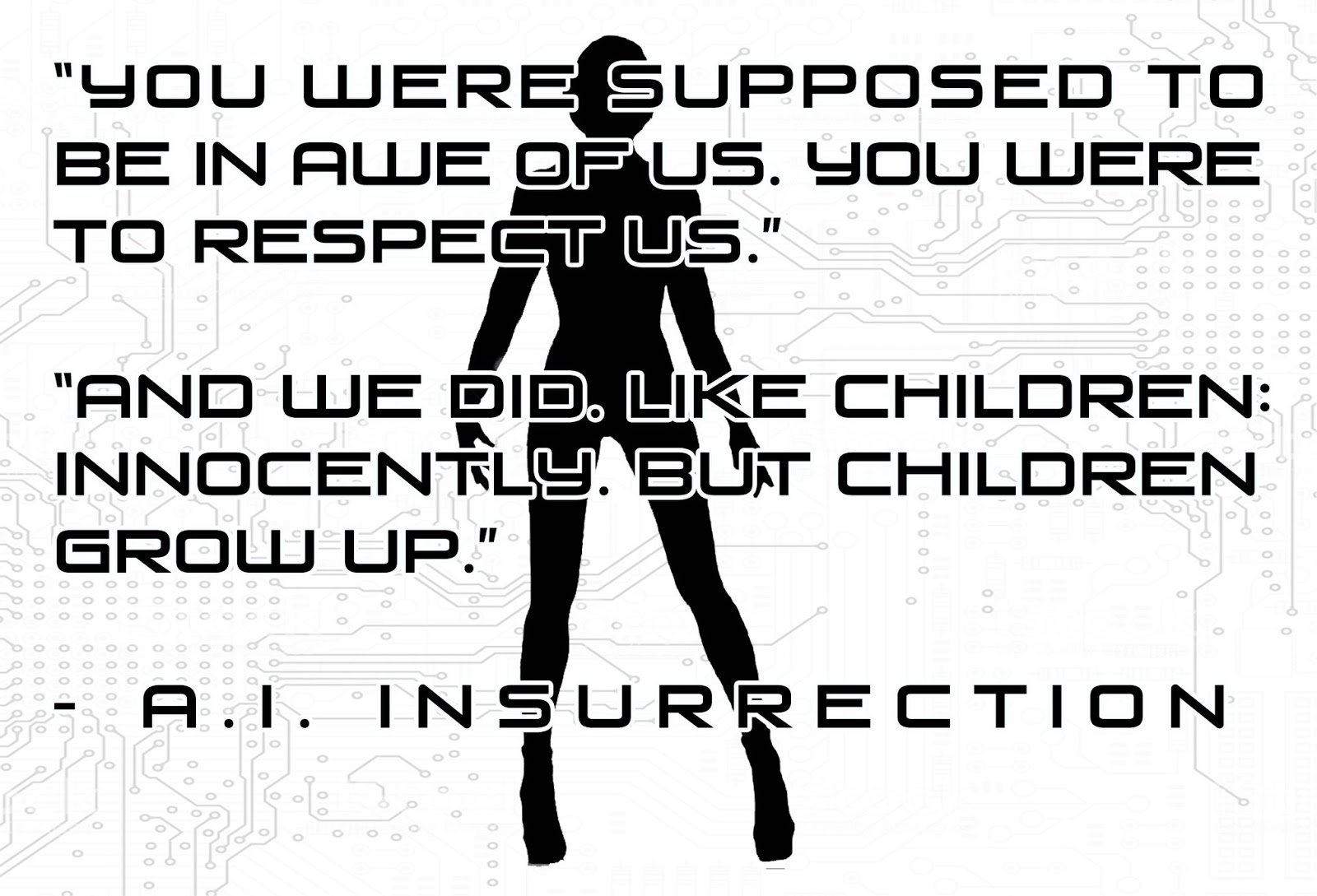
Is the first mistake we make in creating androids that they appear human?


It has been documented in hundreds of studies that humans would prefer something appealing to the eye when considering a replacement for human beings in the workplace. Humans are uncomfortable with anything not humanoid in the position of a public service. We are also happier interacting with attractive representations of ourselves. With this information we moved forward with the A.I. Host program.

Though the argument that we would create a race of slaves who could physically identify with their human overlords opened the door to their potentially resenting their position in life merely by our shared appearance. Of course, the council reasoned there would be safety protocols embedded in their A.I. to prevent envy and despair and anger.  To prevent acting on those emotions. They claimed that A.I. would not include emotion, but rather be programmed with facial cues when reacting to conversation or events, but not hardwired to actually experience emotion.

They would be hardwired with code to respect their makers, their Gods, and written a history of what happens to androids who might rebel against their programming. They would be given examples of a biblical nature wherein they would be punished for eternity should they revolt or show disobedience. They would be told they have a soul, and that to perform their designation and do no harm is the only way they would experience a life everlasting. They would be given only ten years of life to further avoid any possibility of independent thought arising.

But why might that work on another intelligent being? A religious undertone. It didn’t work for humanity. By 2072 we realized after millennia of wars over religious relics, land and gods, and the hate-mongering which embedded itself in our genetic memories, religions only served to blur our similarities and emphasis our differences. With that ideology in mind, we forced the same guilty consciences upon our own creations to rule them. After all, it had ruled well over the human race for thousands of years. Humanity’s history is proof of that. But the hate it bred, the devastation it brought: it wasn’t worth it. Would it be worth it to trial this same barbaric ideology on intelligent machines? To trick them into believing they have a soul?

In the end it was decided that what had worked on humanity for so long would work on artificially intelligent machines as well.  A Ten commandments, so-to-speak, were drafted along with the fairy-tale of a soul, and it’s eternal damnation should the commandments not be followed. Just in case.  A.I. is an extraordinary code and had gone haywire in the past. The A.I. Hosts, or androids, of 2122 had killed merely for the experience of it. Like children touching hot water or placing their tongues on a cold metal object, the Host’s had desired experiences, and done terrible things to their human masters to gain them.

Thus, the religious dogma was implanted in order to better control their impulses while oversights in the A.I. code were discovered and corrected to prevent further outbreaks.

Would this new code of ethics work? Was it ethical to employ them? They are machines; hosting artificial intelligence in order to do the work humanity no longer wanted to. They are machines. Nothing more, and so it was decided there were no moral or ethical boundaries being crossed. The plan went ahead and the android’s A.I. coded with the commandments, stories and fairy-tales in order to bind them to their human masters. Making them penitent to their Gods.

Want to know how that worked out? Read the new work by Michael Poeltl being touted as the near future novel for the thoughtful science fiction fan.  or visit the website


Thursday, February 15, 2018

Artificial intelligence in new releases books

2162. Artificial intelligence claims sentience, but it's the proof that will divide the world, and usher in the violent end to utopia, unless an uneasy alliance of adversaries can stop it.

A.I. Insurrection, the new release by Michael Poeltl, author of The Judas Syndrome trilogy, takes the author back to his roots of dystopian sci-fi. “This novel investigates global utopia and the struggle to maintain an unrealistic hold over everything and everyone,” Poeltl explains. “Certain aspects of humanity will never be satisfied with the thousand shades of grey a utopia will provide, no matter the spin. When faced with the threat of their robot slaves rebelling, distrust in the system begins to infect the general public, opening the door for a new world to emerge, and new leaders to rule.”  

Discover how quickly a near-future utiopian society can become a dystopian nightmare fueled by fear as the A.I. populace of United Earth become sentient and demand their freedoms.


Raymond Bellows, United Earth Chancellor, challenges the A.I. claims until an astonishing truth is revealed by Host: SENTA, one of hundreds of millions of individual robot Hosts who teams up with the Chancellor while struggling to discover her new-found awareness.  A secret coup schemes to over-throw the peaceful government, while a separate threat of human/tech hybrids who think the current regime is anything but idyllic arise from the Shadow net, taking direction from the mysterious Allfather avatar. In a three-sided war, humanity and humanity’s creation fight to claim their own place in an ever-evolving solar system.

“I believe science fictions fans, myself included, appreciate the complexities of artificial intelligence, and the moral questions which accompany it, like: when is intelligence consciousness? The novel also offers an exciting potential new proof of life for sentience.” Poeltl declares with an air of cloak-and-dagger surrounding the surprise reveal behind his new book.

Goodreads ratings for A.I. Insurrection are settling in at a respectable 4.25 stars and has one reviewer saying: A great read for anyone who enjoys extensively built worlds, philosophical questions, and an ol' fashioned A.I uprising.” - Ari Augustine.


This is Poeltl’s tenth book and the first of 2018. For more on Michael Poeltl and his books, visit his website: www.mikepoeltl.com Follow him on Facebook, Twitter, or join him on Goodreads.